NIFLHEIMR — Five Voices from the Frozen Deep
Original Extreme Bass Amplifier Collection | RavenForge × SpectralForge Chimera
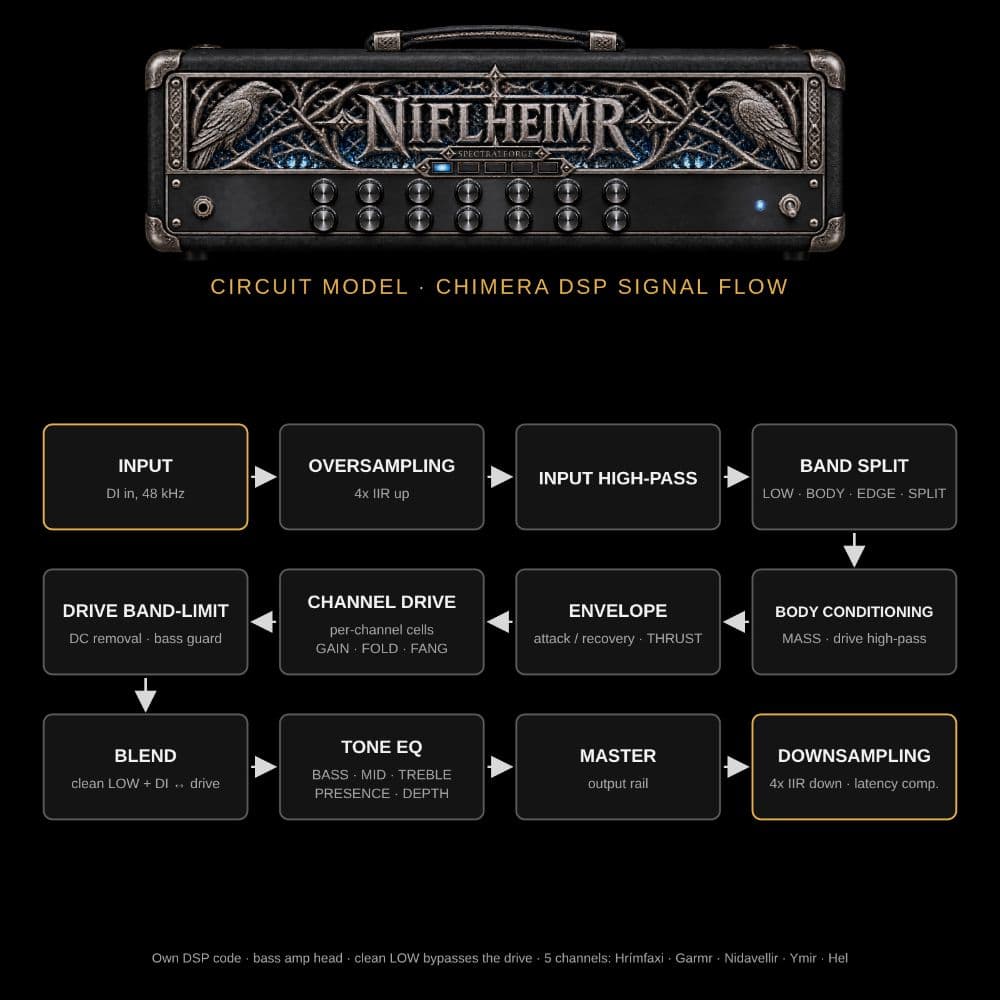
Niflheimr is an original five-channel extreme bass amplifier, designed and coded by RavenForge for SpectralForge Chimera. It is a circuit model of our own DSP code, not a recreation of any commercial amplifier, hardware or plugin.
Niflheimr splits the bass into a clean LOW band and the BODY and EDGE above it. Only the upper bands are driven, so the fundamental stays solid and defined even under extreme distortion. BLEND then mixes the clean DI with the drive. Its five channels take five different approaches to that drive, from tight modern clank to grinding death-metal bite and massive doom fuzz. This pack brings all five into the Neural Amp Modeler ecosystem.
THE FIVE CHANNELS
HRÍMFAXI — The Frost-Maned Steed
Modern and tight: controlled lows, clear string attack and fast recovery. Built for modern metal, djent and tight, articulate rhythm parts where every note has to cut.
GARMR — The Hound at the Gate
Death and grind: upper-band bite driven through serial asymmetric stages, with a tight grind. Built for death metal, grindcore and aggressive picking that needs snarl above a locked-in low end.
NIDAVELLIR — The Dark Forge
Industrial bite: a clean centre with a separately, narrowly driven upper path, for a metallic, mid-forward edge. Suited to industrial, groove and anything that needs the bass to cut through dense guitars.
YMIR — The Primordial Giant
Slam impact: parallel drive with a short, percussive recovery and a hard first hit. Built for slam, brutal death and heavy rhythm parts that live on attack and punch.
HEL — The Queen of the Dead
Sludge mass: an asymmetric mid-body fuzz with a separately articulated edge, for sustained, heavy saturation. Built for sludge, doom and slow, crushing riffs.
CAPTURE OVERVIEW
Source. The original Niflheimr DSP, rendered offline through the plugin's own production signal path (4x oversampling and latency included) at 48 kHz.
Settings. Each channel is captured at the amp settings of its factory rig voicing, BLEND included. Hrímfaxi uses Metal Clank, Garmr the drive lane of Death Grind, Nidavellir the mid lane of Heavy Pulse, Ymir the mid lane of Slam Punch, and Hel Doom Fuzz. Input and output trims are at 0 dB.
Chain. Amp head only. No pedals, compressor, cabinet, microphone, room, effects or post-processing.
Training signal. A synthetic DI-style signal of plucked notes, noise bursts and decays from −30 to −3 dBFS, down to 27.5 Hz. About 2 hours of it trained each model size. Separate held-out signals were kept for validation and testing.
Model. NAM A2. Each file holds both A2-Full and A2-Lite; switch between them with the TONE3000 plugin's NAM A2 Size setting. A2-Lite uses less CPU but is less accurate.
Level. Each model's output is fixed so that its validation signal plays at −20 dBFS RMS through the channel EQ below. Keep Normalize off to preserve the balance between channels.
Accuracy. On the held-out test signal, A2-Full reaches a full-signal ESR of 0.0004 to 0.0008 per channel, with peak level within ±0.25 dB of the source. All five channels passed our A2 release qualification on both the validation and test signals; Hrímfaxi, Garmr and Ymir also pass our stricter reference-fidelity profile on both.
These are neural approximations of the original DSP, not bit-exact replacements. Some nonlinear dynamics and signal-history behaviour can differ from the native Chimera engine, most noticeably right after a very loud passage stops.
CHANNEL EQ (RELEASE VOICING)
Each channel has a six-band POST EQ, placed after the amp, that completes its intended voicing. Each EQ was set against that channel's measured spectrum, so no band the raw voice already pushes is pushed further. In the TONE3000 plugin, enable the block's EQ, set it to POST, and enter the values below.
Band types: band 1 is a low shelf, bands 2 to 5 are bells, band 6 is a high shelf. Each entry is frequency / gain / Q.
HRÍMFAXI
1: 80 Hz / −0.5 dB / 0.7 · 2: 250 Hz / −1.0 dB / 1.0 · 3: 800 Hz / +1.0 dB / 0.8 · 4: 2.2 kHz / +1.5 dB / 0.9 · 5: 4.5 kHz / 0 dB / 1.0 · 6: 8 kHz / −1.5 dB / 0.7
GARMR
1: 80 Hz / −0.5 dB / 0.7 · 2: 300 Hz / −1.0 dB / 1.0 · 3: 1.2 kHz / −1.0 dB / 0.8 · 4: 2.8 kHz / +1.5 dB / 0.9 · 5: 5 kHz / +0.5 dB / 1.0 · 6: 8 kHz / −1.0 dB / 0.7
NIDAVELLIR
1: 80 Hz / +0.5 dB / 0.7 · 2: 300 Hz / −0.5 dB / 1.0 · 3: 1.2 kHz / +1.5 dB / 0.8 · 4: 2.5 kHz / 0 dB / 1.0 · 5: 3.5 kHz / +0.5 dB / 1.0 · 6: 8 kHz / −1.5 dB / 0.7
YMIR
1: 80 Hz / +1.0 dB / 0.7 · 2: 250 Hz / −1.0 dB / 1.0 · 3: 800 Hz / +1.5 dB / 0.9 · 4: 2.5 kHz / +1.0 dB / 0.9 · 5: 4.5 kHz / 0 dB / 1.0 · 6: 8 kHz / −1.0 dB / 0.7
HEL
1: 80 Hz / 0 dB / 0.7 · 2: 250 Hz / −1.0 dB / 1.0 · 3: 600 Hz / +0.5 dB / 1.0 · 4: 1.4 kHz / +1.0 dB / 0.9 · 5: 3 kHz / +0.5 dB / 1.0 · 6: 8 kHz / −0.5 dB / 0.7
Without the EQ, each channel is the raw amp voice, and its level can differ slightly from the calibrated −20 dBFS.
RECOMMENDED USE
Load a channel into the TONE3000 plugin, or into any player that supports NAM A2.
Keep Normalize off, and set the channel's POST EQ from the table above.
Add your preferred bass cabinet IR after the amp.
Adjust input gain to suit your bass, pickups and playing.
For five- and six-string basses and low tunings, BLEND keeps the clean fundamental in every channel, so choose a cab IR with controlled lows rather than adding more low end.
TECHNICAL SPECIFICATIONS
Format: Neural Amp Modeler (.nam), NAM A2 (A2-Full + A2-Lite in one file)
Sample rate: 48 kHz
Channels: 5 (one model each)
Gear type: bass amp head, circuit model of own DSP code
Capture settings: factory rig voicing per channel, BLEND included
Cabinet, microphone, room: not included
Release voicing: channel-specific six-band POST EQ (values above)
Output calibration: −20 dBFS RMS on the validation signal, through the channel EQ
Normalize: off
Post-processing: none
ABOUT THE PROJECT
Niflheimr is part of SpectralForge Chimera, an original amplifier and audio-processing project by RavenForge, currently in development. This NAM collection is a portable way to explore five of Niflheimr's voices outside the native Chimera signal chain.
Five channels. Five shades of frozen destruction. One original bass amplifier architecture.
Developed by RavenForge · Powered by SpectralForge Chimera