TONE3000

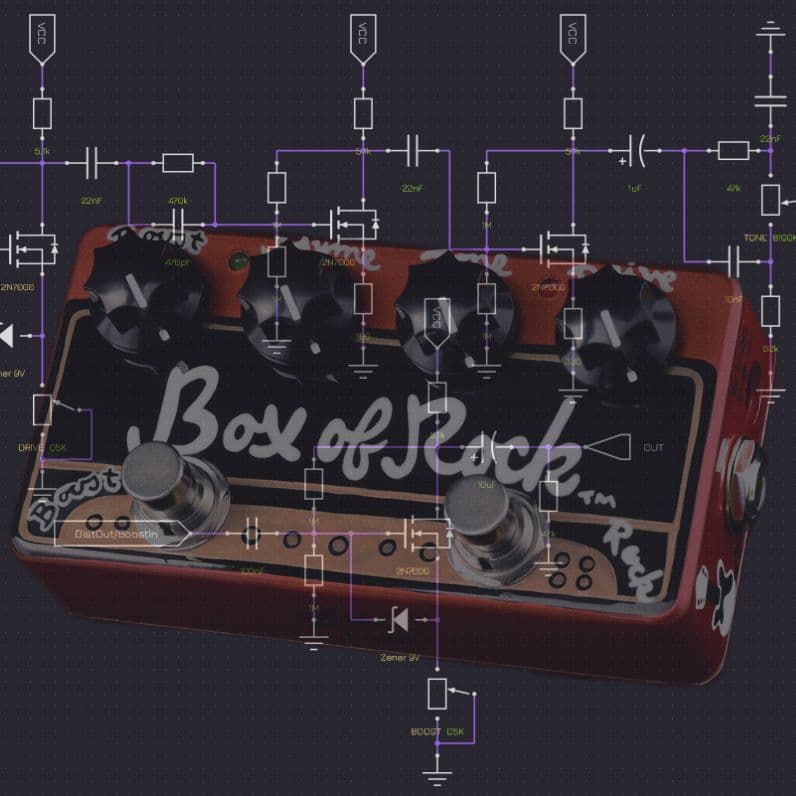
ZVEX Box of Rock CELINE (Calibrated)

Pedal Capture

NAM

metalheart's avatar

metalheart

1h

Description

• Intro: The ZVex Box of Rock is one of the most popular "Marshall-in-a-box" type pedals. It's supposed to emulate the sound of a dimed 1966 Marshall JTM45. It's basically two pedals fused into one enclosure: One distortion circuit that shapes most of the sound and then a transparent boost circuit that can make it very loud if needed. This pack was originally meant to be done with LTspice but in the meantime @celineaudio released an update that added MOSFET support, so it was a perfect opportunity to make my first pack with the Celine simulator instead. It was also a good opportunity to learn the workflow of creating calibrated captures using Celine. Training files were rendered using 16x oversampling for the highest quality possible. • Sound character and intended use: The Box of Rock's sound signature is relatively balanced with a very amp-like touch-sensitive response. It's more of a dirty preamp pedal that adds more gain stages to your amp and not really an overdrive. It's gain can range from slight overdrive to fully saturated distortion and together with the boost it can push the tubes of the amp after it very easily. It might sound weird but the pedal was designed with 1966 Marshall JTM45 as the intended platform. Yes, make the 1966 Marshall JTM45 sound like itself! That's useful in real life when playing live in smaller venues and you can't set the amp itself to very loud levels. Of course you can use other amps with it. I also had good results using Fender Super Reverb captures. I'm sure there are a lot of other amps it pairs well with. Make sure the amp after it is dialed in the clean to edge of breakup territory and the pedal will do the rest. Depending on the amp used after it it's common for low notes to sound muddy with this pedal. If that's the case try turning down the bass at the output of the pedal block. • Settings: For all captures the VOLUME was set at 6 and the BOOST was on and set at 5. That's already plenty loud! DRIVE was set at positions 3, 5, 6 and 8 providing a good range of saturation options. For each of these drive settings TONE was set at positions 3, 5 and 7. I found tone settings out of this range to be either extremely dark or extremely bright. That makes a total of 12 calibrated captures that cover a lot of ground. Setting positions are expressed as rotational ratio (not o'clock!). • Calibration: Calibration metadata is already embedded in the NAM files. Details: Input: +12 dBu ≘ 0 dBFS | Output: +12 dBu ≘ 0 dBFS You only need to enter the headroom of your audio interface's input in dBu inside your NAM host. ⚠️ Note: The original circuit uses BS170 MOSFETs for the gain stages. Celine only has a 2N7000 MOSFET model at the moment, which was used for the simulations. For guitar circuits one can be used in the place of the other and there will be minimal to no difference (in real life we should also remember they have physically opposite pinouts). ⚠️ Note 2: These captures are (input AND output) CALIBRATED! Calibrated NAM captures enable you to experience an accurate gain response, similar to the real hardware, or the simulated hardware in this case. Preferably use an amp capture with calibrated input after them. If you don't know how to set up calibrated NAM chains watch 2dor's tutorials "𝗡𝗔𝗠 𝗰𝗮𝗹𝗶𝗯𝗿𝗮𝘁𝗶𝗼𝗻 & 𝗰𝗮𝗹𝗶𝗯𝗿𝗮𝘁𝗲𝗱 𝗽𝗿𝗼𝗳𝗶𝗹𝗲𝘀: 𝗾𝘂𝗶𝗰𝗸 & 𝗲𝗮𝘀𝘆 [𝟮𝟬𝟮𝟱]" & "𝗦𝘁𝗮𝗰𝗸𝗶𝗻𝗴 𝗰𝗮𝗹𝗶𝗯𝗿𝗮𝘁𝗲𝗱 𝗡𝗔𝗠 (𝗡𝗲𝘂𝗿𝗮𝗹 𝗔𝗺𝗽 𝗠𝗼𝗱𝗲𝗹𝗲𝗿) 𝗽𝗿𝗼𝗳𝗶𝗹𝗲𝘀" on YouTube OR read the "𝗡𝗲𝘂𝗿𝗮𝗹𝗔𝗺𝗽𝗠𝗼𝗱𝗲𝗹𝗲𝗿𝗣𝗹𝘂𝗴𝗶𝗻 𝘃𝟬.𝟳.𝟭𝟮 𝗶𝘀 𝗿𝗲𝗹𝗲𝗮𝘀𝗲𝗱" blog post on the Neural Amp Modeler website. Of course you are free to experiment! Using the Raw option will also preserve the unit's output that is relative to your input signal or just use whatever levels you like more! The calibrated options will just give you the results that are closest to real life. ⚠️ Note 3: These captures are NOT derived from the physical hardware but from circuit simulation done in Celine, an open source real-time circuit simulator. I try to make this very clear in my titles, descriptions and thumbnails so that I don't mislead any people. Of course that doesn't mean they can't sound just as good, provided they are done correctly. Some added bonuses of circuit simulated gear is that component self-noise is usually not simulated, which results in better ESR results, and also that we can capture just the intended circuit and not a chain consisting of unrelated devices like DIs, Reamp boxes, audio interface preamps etc. which imprint their own character to the signal.

Preview

Model
IR
Input

Powered by

NAM Models

Each model captures the gear at specific knob settings.

A2-FullESR: 0.0004

A2-LiteESR: 0.0017

400 Epochs

Sweep

cal.

Captured on

Tone3000 - NAM Captures and IRs

A2-FullESR: 0.0002

A2-LiteESR: 0.0008

400 Epochs

Sweep

cal.

Captured on

Tone3000 - NAM Captures and IRs

A2-FullESR: 0.0002

A2-LiteESR: 0.0008

400 Epochs

Sweep

cal.

Captured on

Tone3000 - NAM Captures and IRs

A2-FullESR: 0.0003

A2-LiteESR: 0.0013

400 Epochs

Sweep

cal.

Captured on

Tone3000 - NAM Captures and IRs

A2-FullESR: 0.0003

A2-LiteESR: 0.0011

400 Epochs

Sweep

cal.

Captured on

Tone3000 - NAM Captures and IRs

A2-FullESR: 0.0003

A2-LiteESR: 0.0013

400 Epochs

Sweep

cal.

Captured on

Tone3000 - NAM Captures and IRs

A2-FullESR: 0.0003

A2-LiteESR: 0.0016

400 Epochs

Sweep

cal.

Captured on

Tone3000 - NAM Captures and IRs

A2-FullESR: 0.0007

A2-LiteESR: 0.0036

400 Epochs

Sweep

cal.

Captured on

Tone3000 - NAM Captures and IRs

A2-FullESR: 0.0004

A2-LiteESR: 0.0017

400 Epochs

Sweep

cal.

Captured on

Tone3000 - NAM Captures and IRs

A2-FullESR: 0.0008

A2-LiteESR: 0.0032

400 Epochs

Sweep

cal.

Captured on

Tone3000 - NAM Captures and IRs

Comments

Share your thoughts...
@username to mention • Ctrl+Enter to submit

License: T3K

Users may download and use the data file in software and publish the resulting outputs without royalties or restrictions. However, they may not upload, republish, or distribute the data file without the author's permission.

Works with TONE3000

Browse and play TONE3000 tones directly in these plugins, pedals and amps.

Pedals and amps

TONE3000 Digital Models

NEW TO TONE3000?

Discover hyper-realistic digital models of iconic gear, including the Fender Twin Reverb, Vox AC30, Marshall JCM 800, and thousands more. Getting started is easy—and free!