TONE3000

Ibanez TS808 Fortin Mod LTspice (Calibrated)

Pedal Capture

NAM

metalheart's avatar

metalheart

2h

Description

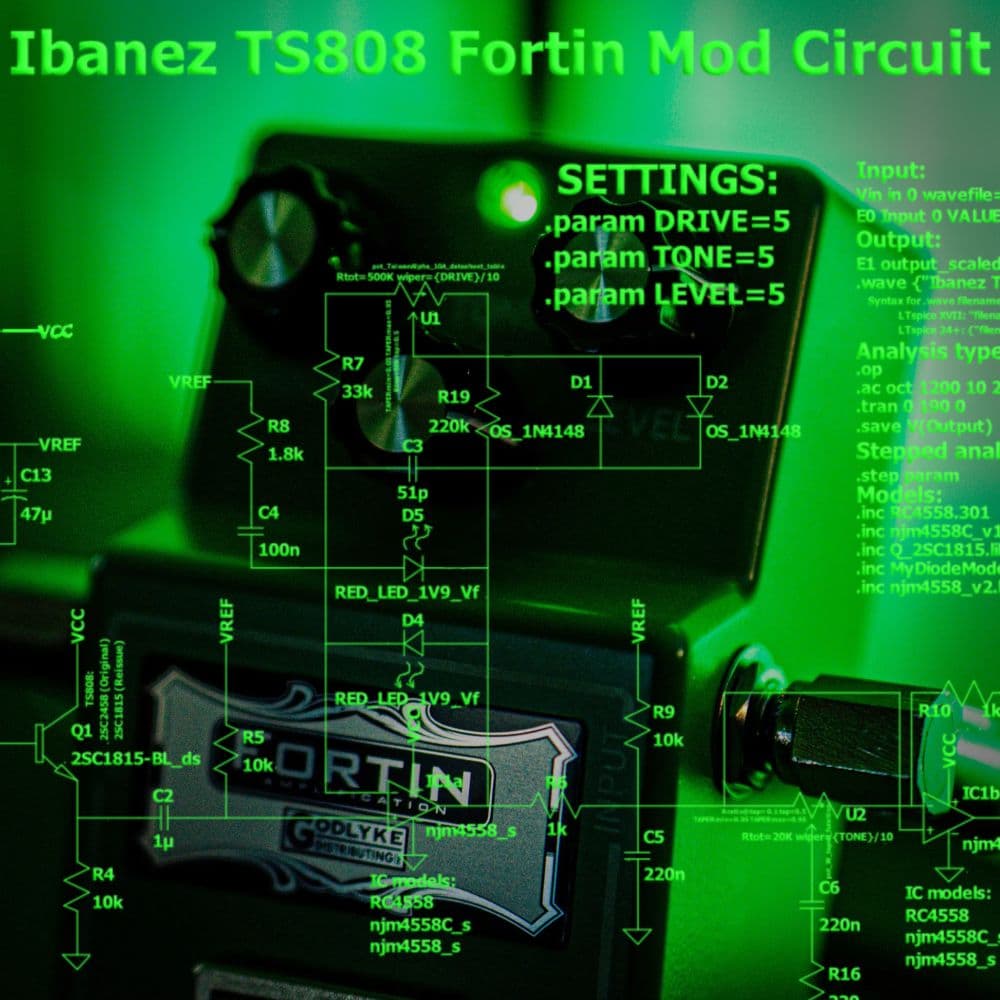
• Intro: In 2022 Fortin and Godlyke collaborated and released a limited run modded version of the classic Ibanez TS808 Tube Screamer. The aim was to create a much meaner version of the legendary pedal, packed with tons of gain and output that appealed to modern rock and metal players. • Sound character: Basically a tube screamer on steroids. Way more output and way more gain. Even at the lowest possible gain setting there's a lot of saturation already. You might notice as gain increases the distortion becomes kind of layered. This is because the mod adds a secondary clipping stage besides the main clipping diodes in the same op-amp. This modded version retains the characteristic mid boost and clearing of low frequencies of the original. I guess this mod was created with modern metal in mind but I personally find it perfect to use it more for pushing old Marshall Plexis for lead tones. It gives a super rich distorted sound, especially with a Klon-type boost in between. • Settings: A good range of tonal options is covered in these captures, from mild boost to full-on distortion and TONE was also set at various positions. You are almost certainly going to find something that works for you in here. • Calibration: Calibration metadata is already embedded in the NAM files. Details: Input: +7.17 dBu ≘ 0 dBFS | Output: +9 dBu ≘ 0 dBFS You only need to enter the headroom of your audio interface's input in dBu inside your NAM host. • Slightly technical info: (TL;DR: some nerdy stuff, you can skip to notes if you are not interested) Special care was taken for each of the non-linearly behaving components: Potentiometers: Tapers were accurately simulated for every knob of the pedal. Specifically, 10A taper (logarithmic) for DRIVE (extracted from a 16mm Taiwan Alpha potentiometer datasheet), B taper (linear) for LEVEL and W taper (S-shape) for TONE. These taper types are the ones found in the original unit too. Potentiometer deadzone was also modeled at the 5% min and max ranges, which is the most common in real life potentiometers. Op-amp: The official JRC4558 SPICE model provided by Nisshinbo/NJM was used. Buffer transistors: 2SC1815 SPICE model made from values extracted from the datasheet. Buffer transistors typically shouldn't affect the sound though. Of all the non-linear components the diodes are probably the top contributors to the sound character of an overdrive pedal. There are two pairs of diodes within the same op-amp loop that are used to clip the signal. Main diodes: RED LEDs with a Vf = 1.9V @ 10mA made by extracting values from a Vishay 3mm red LED datasheet. Secondary diodes: Standard small signal silicon diodes 1N4148. Specific SPICE model based on a datasheet by Onsemi. Vf = 0.72V @ 10mA. The circuit was simulated with a speed of ~200ms/s on my computer. Consequently each simulation with the NAM training wave file took a bit over 15 minutes to complete. Frequency/gain response analysis vs stock TS808: Below you will find a link to the frequency sweep graph from 10 Hz to 25 kHz, which I simulated inside LTspice, containing both the stock and the Fortin modded TS808. The yellow line at 0 dB is the input signal = 1 Volt peak sine wave used to generate the output lines (green and blue). All 3 knobs were set at noon for both circuits. The first thing you might notice is the greater than 15 dB difference in output. Other than that the frequency balance doesn't shift very drastically. The stock TS808 has a peak frequency of ~800 Hz and the Fortin TS808 has it at ~900 Hz. The Fortin TS808 also has a slightly more aggressive roll-off at the higher frequencies, still a ~15dB difference at 5000 Hz. I wouldn't care about higher frequencies than that as they wouldn't pass past a typical guitar speaker. Overall the frequency character stays practically the same. https://i.imgur.com/7xLreme.png Here's also the transient analysis comparison generated from a 1kHz sine wave input. There isn't much to comment here. There is a slight change to the waveform but not anything radical between the two. Apart from slight phase shift to the input signal and of course the difference in output levels, the stock TS808 has a slightly more rounded, less aggressive peak. https://i.imgur.com/cEqMekw.png I'm also very happy with how the NAM files turned out. The error to signal ratio (ESR) ranges from 0.0001 to 0.0006. These values are extremely low, especially considering the layered and high-gain distortion nature of the pedal. For reference an ESR that is 0.01 or smaller is considered very accurate for a NAM capture. ⚠️ Note: These captures are (input AND output) CALIBRATED! Calibrated NAM captures enable you to experience an accurate gain response, similar to the real hardware, or the simulated hardware in this case. Preferably use an amp capture with calibrated input after them. If you don't know how to set up calibrated NAM chains watch 2dor's tutorials "𝗡𝗔𝗠 𝗰𝗮𝗹𝗶𝗯𝗿𝗮𝘁𝗶𝗼𝗻 & 𝗰𝗮𝗹𝗶𝗯𝗿𝗮𝘁𝗲𝗱 𝗽𝗿𝗼𝗳𝗶𝗹𝗲𝘀: 𝗾𝘂𝗶𝗰𝗸 & 𝗲𝗮𝘀𝘆 [𝟮𝟬𝟮𝟱]" & "𝗦𝘁𝗮𝗰𝗸𝗶𝗻𝗴 𝗰𝗮𝗹𝗶𝗯𝗿𝗮𝘁𝗲𝗱 𝗡𝗔𝗠 (𝗡𝗲𝘂𝗿𝗮𝗹 𝗔𝗺𝗽 𝗠𝗼𝗱𝗲𝗹𝗲𝗿) 𝗽𝗿𝗼𝗳𝗶𝗹𝗲𝘀" on YouTube OR read the "𝗡𝗲𝘂𝗿𝗮𝗹𝗔𝗺𝗽𝗠𝗼𝗱𝗲𝗹𝗲𝗿𝗣𝗹𝘂𝗴𝗶𝗻 𝘃𝟬.𝟳.𝟭𝟮 𝗶𝘀 𝗿𝗲𝗹𝗲𝗮𝘀𝗲𝗱" blog post on the Neural Amp Modeler website. Of course you are free to experiment! Using the Raw option will also preserve the unit's output that is relative to your input signal or just use whatever levels you like more! The calibrated options will just give you the results that are closest to real life. ⚠️ Note 2: These captures are NOT derived from the physical hardware but from circuit simulation done in a SPICE environment. I just want to be transparent about that and not mislead people. Of course that doesn't mean they can't sound just as good, provided they are done correctly. An added bonus of SPICE simulated gear is that component self-noise is usually not simulated, which results in better ESR results.

Preview

Model
IR
Input

Powered by

Models

Each model captures the gear at specific knob settings.

A2-FullESR: 0.0004

A2-LiteESR: 0.0007

400 Epochs

Sweep

cal.

Captured on

Tone3000 - NAM Captures and IRs

A2-FullESR: 0.0002

A2-LiteESR: 0.001

400 Epochs

Sweep

cal.

Captured on

Tone3000 - NAM Captures and IRs

A2-FullESR: 0.0002

A2-LiteESR: 0.0004

400 Epochs

Sweep

cal.

Captured on

Tone3000 - NAM Captures and IRs

A2-FullESR: 0.0003

A2-LiteESR: 0.0005

400 Epochs

Sweep

cal.

Captured on

Tone3000 - NAM Captures and IRs

A2-FullESR: 0.0002

A2-LiteESR: 0.0004

400 Epochs

Sweep

cal.

Captured on

Tone3000 - NAM Captures and IRs

A2-FullESR: 0.0001

A2-LiteESR: 0.0005

400 Epochs

Sweep

cal.

Captured on

Tone3000 - NAM Captures and IRs

A2-FullESR: 0.0003

A2-LiteESR: 0.0005

400 Epochs

Sweep

cal.

Captured on

Tone3000 - NAM Captures and IRs

A2-FullESR: 0.0002

A2-LiteESR: 0.0004

400 Epochs

Sweep

cal.

Captured on

Tone3000 - NAM Captures and IRs

A2-FullESR: 0.0002

A2-LiteESR: 0.0003

400 Epochs

Sweep

cal.

Captured on

Tone3000 - NAM Captures and IRs

A2-FullESR: 0.0001

A2-LiteESR: 0.0007

400 Epochs

Sweep

cal.

Captured on

Tone3000 - NAM Captures and IRs

Comments

Share your thoughts...
@username to mention • Ctrl+Enter to submit

License: T3K

Users may download and use the data file in software and publish the resulting outputs without royalties or restrictions. However, they may not upload, republish, or distribute the data file without the author's permission.

Works with TONE3000

Browse and play TONE3000 tones directly in these plugins, pedals and amps.

Pedals and amps

TONE3000 Digital Models

NEW TO TONE3000?

Discover hyper-realistic digital models of iconic gear, including the Fender Twin Reverb, Vox AC30, Marshall JCM 800, and thousands more. Getting started is easy—and free!