TONE3000

BOSS TU-2 Chromatic Tuner Undervoltage Distortion

Experimental Capture

NAM

dronek's avatar

dronek

1h

Description

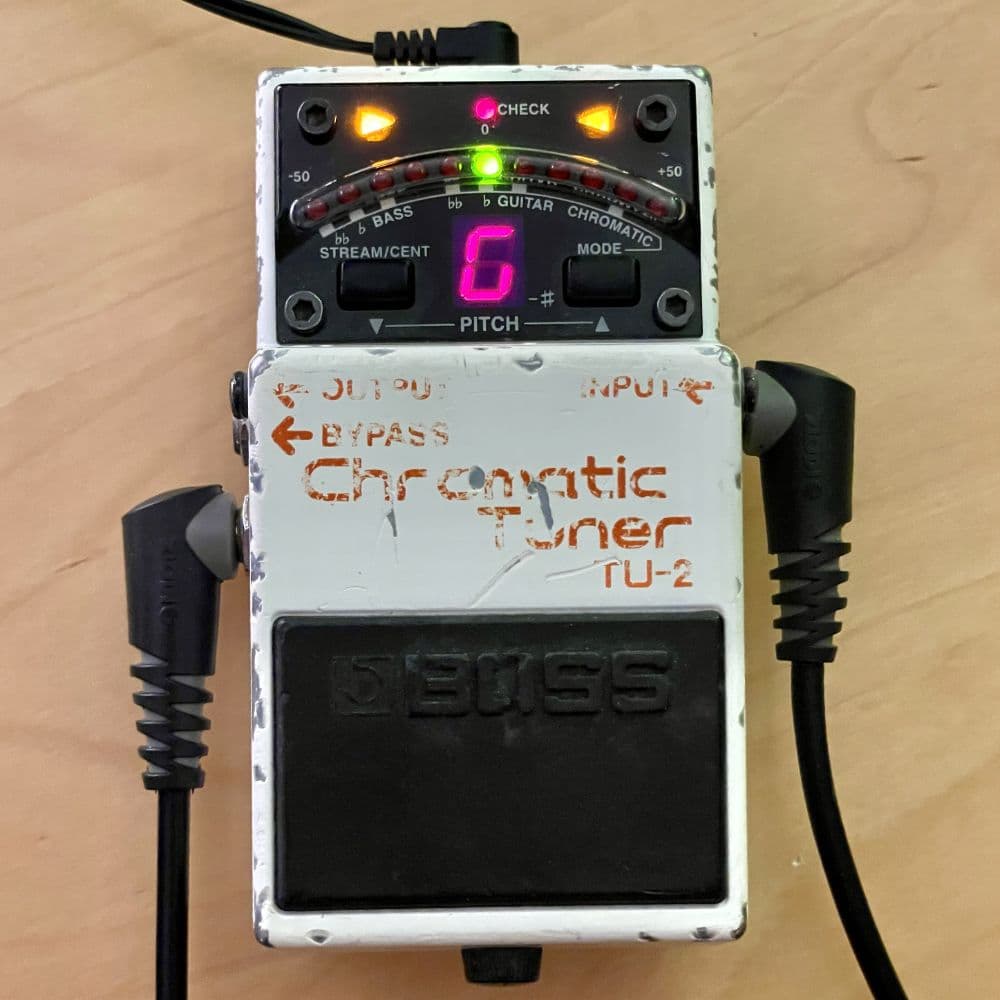
Yes, this is a capture of a tuner. No, the tuner is not the point. The TU-2 has been sitting at the start of countless pedalboards since 1998, silently judging your pitch. It has LEDs that flicker with the confidence of a first-year violin student, a rugged metal case that has survived more stage dives than most drummers, and a footswitch that has been stepped on by everyone from bedroom players to touring professionals. It has never complained, which is more than I can say for the singer. Strictly speaking, a tuner makes no sound, and a capture of its tuning function would be a very expensive way to record nothing. What this profile captures is the TU-2 in bypass mode, where its buffer circuit is still working. The serious part: The TU-2 uses buffered bypass. Even when the tuner is off, your signal passes through an active buffer. You may or may not hear a slight coloration when using the NAM profile. In addition to a profile of the tuner in its standard configuration you will also find three other profiles uploaded here. The ones denoted with an "_H" are captured with a passive pickup emulation circuit chained before the tuner. But there's more... the 2V captures: This is the TU-2 captured in a way Boss never intended and no pedalboard guide recommends. It’s the same tuner as before, but powered with 2V instead of the 9V it was designed for. The TU-2 usually has one job, which is to sit quietly at the front of your chain. At 2V it has to work with far less electrical headroom than it was built for, and the result is a pedal that tries its best and ends up on the edge of failing, which turns out to be an interesting place for it to be. 2V was the lowest voltage at which the buffer still passed any signal in my testing, so this capture sits at the edge of what the circuit can do. Any lower and the pedal passes nothing. An active buffer needs enough supply voltage for the signal to swing without hitting its limits. At 9V there’s plenty of room, so the buffer stays clean and just does its job of impedance matching. As the supply voltage drops, that room shrinks, and a guitar signal can reach the limits of what the circuit can reproduce. When it does, the waveform flattens at the peaks and you hear distortion. Here it’s a slight, interesting grit. However, together with the interesting grit comes a significant drop in the output level. Therefore you will find a 2V capture done in a standard way and a "2V - amplified" capture where I used the input gain of my audio interface to amplify the low signal. The latter one is also calibrated to act as a slight boost but you can easily adjust its level in your software. This "2V - amplified" version makes the distortion most audible and therefore I put it first in the list here.

Tags

Preview

Model
IR
Input

Powered by

NAM Models

Each model captures the gear at specific knob settings.

cal.

cal.

cal.

cal.

Comments

Share your thoughts...
@username to mention • Ctrl+Enter to submit

License: T3K

Users may download and use the data file in software and publish the resulting outputs without royalties or restrictions. However, they may not upload, republish, or distribute the data file without the author's permission.

Works with TONE3000

Browse and play TONE3000 tones directly in these plugins, pedals and amps.

Pedals and amps

TONE3000 Digital Models

NEW TO TONE3000?

Discover hyper-realistic digital models of iconic gear, including the Fender Twin Reverb, Vox AC30, Marshall JCM 800, and thousands more. Getting started is easy—and free!