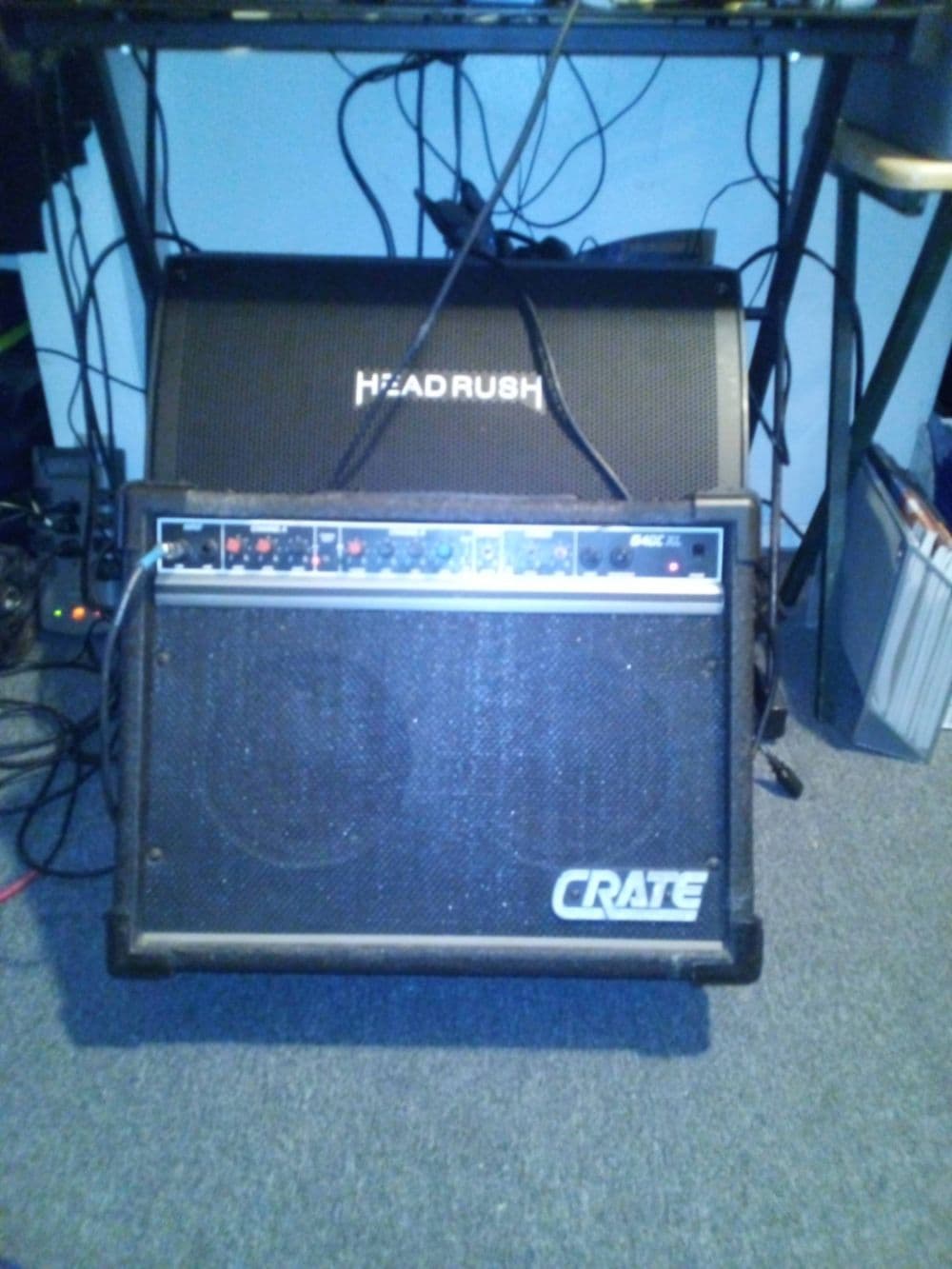
The Crate G‑40C was my first amp as a kid — the one I learned to play on. I don't have that original anymore, so I picked up this used G‑40C XL to get the sound back. This project is about capturing it properly so that voice never really dies.
In memory of Danny Wannamaker, who taught me to appreciate this amp. Rest in peace Brother.
Dan's Settings:
Stereo Chorus — how to get the G‑40C XL's chorus
This capture is the distortion channel only, taken from the amp's Line Out. To get the full G‑40C XL sound, add a chorus after your cab IR.
The amp's chorus is an analog bucket‑brigade (BBD) stereo chorus — a Panasonic MN3007 delay chip with an MN3101 clock and an NE555 sweep, the same family as a Boss CE‑2 or a Roland Juno. Any BBD/Juno‑style chorus gets you there. Two free ways:
Option A — TAL‑Chorus‑LX (free plugin, any DAW)
Download from https://tal-software.com/products/tal-chorus-lx (Windows / macOS, VST3 / AU).
Run the installer, then rescan plugins in your DAW if it doesn't appear.
Add it last in the chain — after the amp NAM and the cab IR.
Settings for this amp's voice: "1" mode / one voice, Rate slow (~0.4–0.6 Hz), Wet and Dry roughly equal (~50/50). That's the deep, slow, three‑dimensional setting the G‑40C XL is known for. Amp Rate knob = plugin Rate; amp Depth knob ≈ Wet amount.
Option B — REAPER's built‑in chorus (no download)
On the track, click FX → Add → JS (JesuSonic) → search chorus → JS: Chorus (Stereo) (or JS: Guitar/chorus).
Place it after the amp NAM and cab IR.
Settings: Rate ≈ 0.4–0.7 Hz, Depth / Range around 60–75%, Wet / Mix ≈ 50%, Feedback low, Stereo width up.
Save it with the amp: FX → Save all FX as chain…
Either route is mono‑in, stereo‑out — the chorus is what makes the rig stereo. Leave it bypassed for a tight dry rhythm tone; switch it on for cleans and leads.
Crate G‑40C XL — History and Future
The Crate G‑40C was my first amp as a kid — the one I learned to play on. I don't have that original anymore, so I picked up this used G‑40C XL to get the sound back. This project is about capturing it properly so that voice never really dies.
Origin. The G‑40C XL came out of St. Louis Music (SLM Electronics), the St. Louis company that had built instruments since 1922 and launched the Crate brand at the end of the 1970s — the name a nod to the bare plywood cabinets of the first models. By the mid‑1990s Crate was SLM's workhorse guitar line: cheap, loud, and built for players who wanted a real high‑gain sound with no tube budget. This model (owner's manual dated 12/95) is a 40‑watt solid‑state stereo chorus combo — an 8" speaker, a footswitchable clean channel with a three‑band stack, an all‑analog BBD stereo chorus, spring reverb, and the reason anyone still talks about it: a genuinely vicious solid‑state distortion channel.
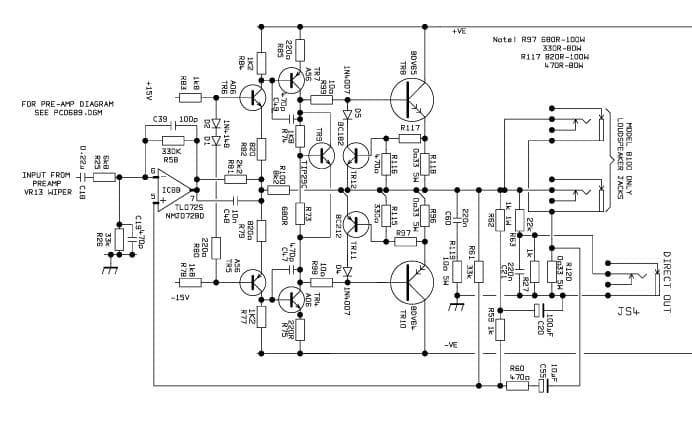
The circuit. Channel A doesn't imitate a tube amp. It runs a chain of RC4558 op‑amp gain stages — the spec sheet lists 88 dB of system gain at 1 kHz — straight into a pair of LEDs wired anti‑parallel to ground. The op‑amps drive the signal into the rails, the LEDs chop the peaks into a hard, symmetrical clip, and a single Contour control sweeps from a mid‑forward voice to a deep mid‑scoop at the top of its travel. Brick wall into diodes. It's the core of the sound SLM pulled out of budget parts in that era, and the lineage runs back through the late‑'80s Crate G‑series.
The Ampeg and death‑metal connection. SLM had owned Ampeg since 1986, and the two brands shared a building and an engineering team in St. Louis. The same design idea — huge op‑amp gain dumped into hard clipping — shows up in Ampeg's solid‑state guitar amps of the period, above all the Ampeg VH‑140C head and its SS‑series combo siblings. The VH‑140C had a strange afterlife: it became a cult death‑metal amp, the dry, tight, chainsaw rhythm tone behind a stack of Scandinavian and American records, and today it's one of the most cloned solid‑state preamps in the capture and plugin world. Techs and players have long pointed out the family resemblance between the Crate G‑series distortion channel and that Ampeg circuit — same company, same era, same recipe. (The VH‑140C is roughly contemporary with this combo rather than a later spin‑off of it, so it's shared DNA, not a straight hand‑me‑down — but the DNA is unmistakable, and it predates both amps in the earlier Crate G‑series.)
The future. This particular G‑40C XL is being preserved the modern way: a Neural Amp Modeler capture taken direct from the amp's Line Out with the Contour at 2 o'clock, so the exact voice of this unit — pots, wear, and all — survives as a profile that loads in any DAW long after the original 8" speaker gives out. Paired with an impulse response of its own cabinet and a DSP version of the stereo chorus, the goal is a faithful software rebuild of the whole amp: the same brick‑wall distortion that tied this cheap combo, through its Ampeg cousins, to the sound of an entire genre.