MARSHALL VALVESTATE 8080 / 8100 - OVERDRIVE (OD2) CHANNEL, BOOSTED
===================================================
WHAT IT IS
----------
A Neural Amp Modeler capture of the Marshall
Valvestate 8080 / 8100 OVERDRIVE channel in OD2
(high-gain) mode with the CH Boost engaged - the
tight, cold, aggressive Valvestate rhythm voice.
TWO VERSIONS, same capture underneath:
* "Preamp DI (no cab)" - preamp only. NO cab,
NO power amp. Stack your own guitar cab IR
after it (a 4x12 V30 is the right call; the
amp's own line out is famously fizzy). Use
this if you want to pick your own IR or run
it inside a bigger chain.
* "V30 4x12 (cab baked in)" - full chain, plug
in and go. A Celestion V30 4x12 with an
SM57-style mic position (lightly voiced) is
already convolved into the model. No
separate IR block needed. Use this on
hardware where a shorter signal chain keeps
the response tighter and the CPU load down -
HeadRush Prime and similar.
Both are the SAME amp capture at the SAME
settings; the only difference is whether the cab
is in the model.
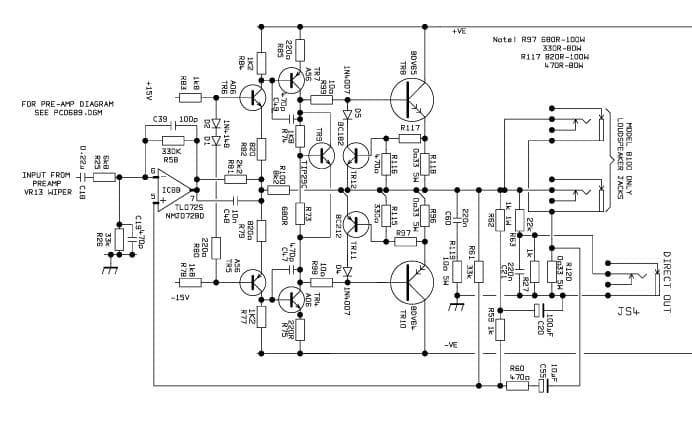
It is NOT a mic'd capture of a real head. It is
a capture of a circuit model: the OD channel was
rebuilt stage by stage in LTspice from the
factory schematic (Marshall drawing PC0689,
issue 5, 1994), then dialed in by ear against a
known-good capture of a real Valvestate 8100
until the two matched.
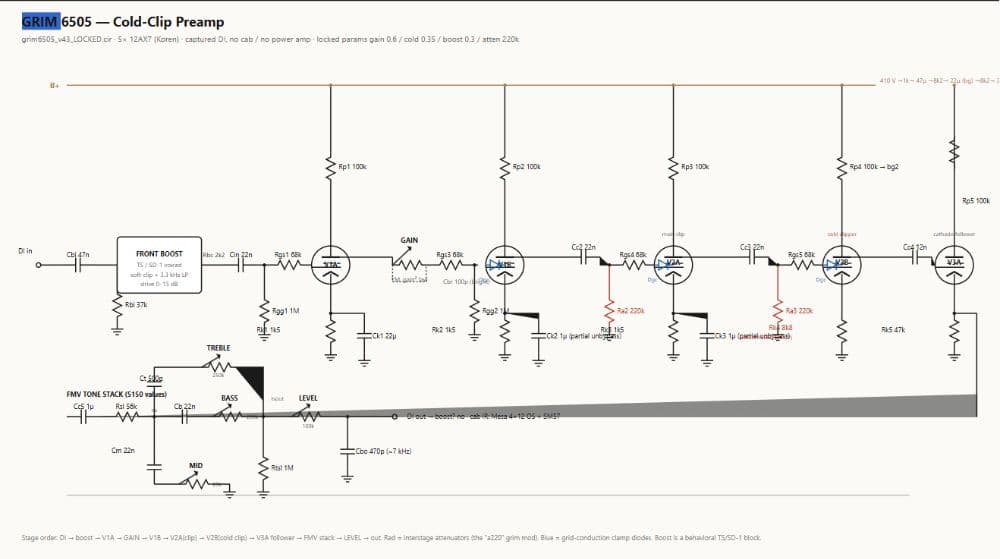
Signal chain modeled:
front boost (BC184 / MPSA13 stage) -> IC1B
TL072 frequency-shaped input -> IC1A gain ->
OD2 gain-mode resistor -> IC3B (M5201S, GAIN
pot in the feedback loop) -> LED6,7 hard
clip -> V1a 12AX7 gain stage -> V1b 12AX7
cathode follower -> Marshall FMV tone stack
-> IC4 buffer -> CONTOUR network -> VOLUME
-> IC5B make-up gain -> [V30 4x12 IR on the
cab version] -> out.
Architecture 2 (A2 / PackedWaveNet, 10+20
channels). Trained on the TONE3000 standard
sweep pushed through the circuit model.
HOW IT WAS MADE - AND THE FIGHTS ALONG THE WAY
---------------------------------------------
The Valvestate is a hybrid: ONE 12AX7 doing the
real work in the middle of a chain of op-amps,
with hard LED clipping ahead of the tube. That
combination made the model fight back the whole
way. For anyone building their own, here is
where it went wrong and how it got fixed:
1. CATHODE FOLLOWER WAS BLOCKING. First
builds "cut in and out" on sustained
notes. Cause: I AC-coupled the follower's
grid and gave it a grid-leak to ground,
which biased it at 0 V and parked it near
cutoff. The real schematic DC-couples
that grid straight to the previous plate,
and the 100n / 220k around it is a cathode
bootstrap, not a coupling cap. Fixed both.
2. THE TUBE WAS SLAMMING THE RAILS. The
12AX7 model has no grid current, so the
+-1.7 V LED-clip signal drove the tube's
grid well positive and the plate swung the
full HT rail - and then every op-amp
downstream squared up too. A real tube
grid-conducts and clamps right there.
Modeled that clamp, plus a small trim on
the drive into the grid. That alone took
it from "buzzsaw" to "amp".
3. IT WAS BRITTLE / HARSH ON TOP. The
behavioral op-amp stages have none of the
stray capacitance a real board has, and
the Koren tube model leaves out the
grid-to-plate (Miller) capacitance that
rolls a real 12AX7 stage off hard. Added
the Miller cap at its real ~1.6 pF value,
a gentle high-frequency cut between the
follower and the tone stack, and switched
off the bright cap across the GAIN pot
(it exists to add fizz). Ear pain gone.
4. THE CONTOUR CONTROL SCOOPED BACKWARDS.
My first pass at the CONTOUR network was a
guess and it deepened the mid-notch when
it should have filled it. Rebuilt it as
the real passive network from the print -
a variable-centre mid-notch plus a mild
high cut whose depth tracks the pot.
5. THE PICK ATTACK ("SNAP") WENT MISSING.
All that high-frequency taming in step 3
also dulled the note onset. Snap and fizz
live in different places, though - snap is
the fast 2-5 kHz transient, fizz is
sustained 8-16 kHz. Sharpening the
LED-clip edge back up and pulling the
Miller cap to its true value gave the
attack back without the harshness.
6. IT SOUNDED THIN / HOLLOW NEXT TO THE REAL
AMP. Bass and treble matched, but the
middle felt empty and the notes did not
"bloom" the way the reference did. The
answer was obvious in hindsight: the
reference was captured with the CH Boost
ENGAGED, and my model had no boost at all.
A boost compresses the input envelope and
pushes the whole amp into a denser, more
sustained regime. Added the boost stage
and the hollowness filled in.
Final result: against a known reference capture
of the same amp, through the same cab IR and
level-matched, the preamp sits within about
1-2 dB per band across the spectrum, with
matching crest / saturation.
SETTINGS CAPTURED
-----------------
One fixed snapshot of the circuit:
- MODE ....................... OD2 (high gain)
- CH BOOST ................... engaged
- OD GAIN ................... ~ noon
- BASS ..................... just above noon
- MID ...................... just above noon
- TREBLE ................... noon
- CONTOUR ................. backed off the
scoop (~9 - 10 o'clock) - fatter mids
than the classic Valvestate smile
- OD VOLUME ................. low
- CAB (cab version only) ... Celestion V30
4x12, SM57-style position, lightly voiced
Not in the capture:
- PRESENCE - it is a power-amp NFB control,
not preamp. Add a gentle high-shelf
downstream if you want the top rolled back.
- The solid-state power section. Push a
power-amp sim if you want the last bit of a
cranked Valvestate's grind.
RECOMMENDED USE
---------------
- Run it RAW (loudness normalize OFF).
- Input calibration: +12 dBu (the usual
default). Feed a normally-tracked DI at its
natural recorded level - it tracks pick
dynamics.
- The CH Boost is already baked in - you do
NOT need an overdrive in front for that
tight low end. A light boost still stacks
fine if you want more.
- No-cab version: stack a 4x12 V30 IR after
it, then your usual post EQ / bus chain.
- Cab version: the cab is baked in - do NOT
add another IR. Go straight to your post
EQ / bus chain.
DIALING NOTES
-------------
- Too bright? High-shelf cut around 3 kHz
(this is your "presence down"), or a darker
57 IR on the no-cab version.
- Want the classic Valvestate scoop? This is
deliberately fatter in the mids than a stock
"CONTOUR at 3 o'clock" - carve a mid dip
around 500-700 Hz downstream to get there.
- Want more gain? A distortion / overdrive -
or a NAM of one - in front. The capture is
chunky enough to sit under a smoother, finer
distortion and stay defined.
- Want a different cab? Use the no-cab
version and load your own IR.
- Responds to the guitar volume knob - roll it
back for crunch.
CREDITS
-------
- Circuit source: Marshall factory schematic,
drawing PC0689 (issue 5, 1994), Valvestate
8080 / 8100.
- Circuit modeling, voicing, cab choice, NAM
training: edgiljr5
===================================================